Battambang, Cambodia has been a great experience, thanks largely to our tuk tuk driver, Chinchin. We hired Chinchin to take us to a couple of temples, but he also took us all over the countryside to see more of the real Cambodia. Yesterday he took us to rice fields, peanut fields, fruit farms, and even to a market where fruit bats inhabit the trees (those suckers are HUGE!). First we went to the bamboo train. It is basically a platform that runs full speed along some very rickety tracks. I think the locals use it to get from A to B quickly. Tourists use it just for the experience. The thing goes so fast and "cars" run in both directions, so when one is coming straight at you, you just have to hope your driver (the guy behind you running the motor) sees it. When there is a jam like this, they just lift the platform off the tracks and let one another through. Here we are on the bamboo train, just at the beginning:
Here's Oli helping our driver get the car facing the other direction so we could go back.
After the bamboo train and Chinchin's tour of the countryside, we went to Banon Temple. I think we must have walked over 1,000 steps to the top, but it was pretty. Then we went to the killing caves, where the Khmer Rouge executed more thousands of people. Being in these places, there's an overwhelming feeling of sadness. It's unbelievable that so many people went through so much terror.
Today we went again with Chinchin to see a temple just north of the city. Along the way we stopped at a local market which was really interesting. Then we stopped at a small village where they make bamboo sticky rice. Chinchin said they make the rice in the bamboo because it's easier to carry with you when going to the fields for work. It was quite tasty.
After the sticky rice, Chinchin took us to the river to a fish market. In this area their primary harvest is rice but they also consume and sell loads of fish from the river. We saw them drying the fish, fermenting the fish, and making fish paste (which smelled as awful as it sounds).
Here's Chinchin at a "petrol station" filling up. It's cheaper for them to get gas from Thailand so they bring it over in bottles. You see a lot of strange colored coke and fanta around here.
We also went to another killing field. Here, Chinchin told us his family's story during the Khmer Rouge era. The more I learn about this time, the less I'm able to wrap my head around it. It's just so hard to understand the cruelty and horror behind all of the killings. There was a memorial here housing skulls, clothing, and bones of the victims. The memorial also has stone carvings showing many of the horrible things the Cambodian people had to endure during this time. Here's some writing from the memorial, very well said I think.
11.27.2011
Phnom Penh
We'll start out on a light note, cause this will get a bit dark.
Siem Reap was a blast! We got to see the wonders of Angkor during the day and hit pub street at night. Here we are on our last night in Siem Reap, with Lucie and Edgar (and another couple who joined us for a couple buckets):
We only spent a couple days in Phnom Penh. On our one full day we visited The Choeung Ek killing fields and the S 21 museum. Choeung Ek, 17km outside of Phnom Penh, was once a Chinese graveyard but is now known as the "killing fields", used by the Khmer Rouge between 1975-1979. Here they executed thousands (17,000 according to wikipedia).
This is a photo of one of the mass graves discovered after the Khmer Rouge rule ended. Almost 9,000 bodies have been found so far at the killing fields. Bones, teeth, and clothing are still found all over the grounds, washing up after the rainy seasons. The ground are full of mass graves. There is a memorial stupa when you first enter the field. Inside is a glass case with level after level of bones recovered from the many mass graves. On the lower levels are the skulls, separated by age and sex. It's a really haunting display.
This is called the "killing tree". Here, the KR killed children by throwing them against the tree. The killing fields were first discovered after the Khmer Rouge rule ended. People started coming back to Phnom Pen (they had been forced to the countryside by the KR) and walking past the fields they noticed the stench. One witness says the tree was covered in blood and brains when he found it. Bullets were too expensive so they chose to execute their victims with their hands. They used the tree for children and used tools such as machetes and hammers on the adults. This often caused a long and tortuous execution. They had loud speakers set up in the trees playing music to drown out the screams of their victims.
This is the Tuol Sleng Genocide Museum. It's a former school and was used as the S-21 security prison by the Khmer Rouge. Many of the people executed at the killing field were once prisoners here. The prison was used mainly for detaining and torturing "enemies" of the KR. Many were tortured for days and weeks until they confessed to outrageous allegations, such as being spies for the CIA or KBG. Once they signed confessions they were taken to be executed. Many prisoners were also forced to name their family and friends as associates so that the KR could arrest, torture, and execute more people. It's estimated about 20,000 prisoners were detained at S-21. Of these, 7 survived.
Before coming to Cambodia, I knew nothing of the events of this time. I can't believe all this happened just over 30 years ago and I've never heard of the Khmer Rouge until now. It's hard to believe it really happened, that such a mass genocide could have happened during our lifetimes. The Khmer Rouge case trials are currently taking place.
More on the Khmer Rouge from our good friends at Wikipedia: http://en.wikipedia.org/wiki/Khmer_rouge
victims of S-21
11.22.2011
Angkor
We've spent the last few days based in Siem Reap, Cambodia and visiting the ancient city of Angkor. Angkor is a region of Cambodia that served as the seat of the Khmer empire from approximately the 12th-15th centuries (that's a direct quote from Wikipedia...to learn more: http://en.wikipedia.org/wiki/Angkor). It's a huge area of centuries old temples and it really is amazing. We spent one whole day visiting temples on bicycles and another day seeing the ones further out in a tuk tuk. Luckily, we ran into Lucy and Edgar, who we met a couple times in Bangkok, and got to see the temples with them. There are loads of temples in Angkor with Angkor Wat being the largest and most well preserved temple.
Another wiki fact that is pretty interesting:
In 2007, an international team of researchers using satellite photographs and other modern techniques concluded that Angkor had been the largest preindustrial city in the world, with an elaborate system of infrastructure connecting an urban sprawl of at least 1,000 square kilometres (390 sq mi) to the well-known temples at its core.[2] The closest rival to Angkor, the Mayan city of Tikal in Guatemala, was between 100 and 150 square kilometres (39 and 58 sq mi) in total size.[3] Although its population remains a topic of research and debate, newly identified agricultural systems in the Angkor area may have supported up to one million people.
I would think you could spend months here just exploring all that is in Angkor. It's one thing I knew very little about before starting this trip but now am so glad I've seen. Also, Siem Reap is a very happening city with loads of bars and restaurants catering to tourists. We've been able to try great local Khmer food and also have yummy $1 tacos and $1.50 margaritas. I wouldn't have thought it before coming here, but it's a great vacations spot, even if you just have a week or two.
Here's a few photos. To be honest, I have no idea what the names of these different temples are, sorry!
11.19.2011
Ko Samet
For various reasons we decided not to travel to Laos, so instead we took a little getaway down to the island of Ko Samet.
I've heard the beaches further south (where we're going with Kate in a few days!!) are even more beautiful, but this little place was perfect for a couple days of relaxation. The people are super relaxed and the water is crystal clear. I learned that the Thai sun is much stronger than I gave it credit for, I'll have to find some SPF 50 before heading down south. All in all, it was a great side trip, and now we've moved onto Cambodia.
On the beach
Beach
Enjoying the shade of a beach umbrella
Sunnies shot
Leaving to catch the ferry
11.12.2011
Elephant Nature Park
We went just outside of Chiang Mai to the Elephant Nature Park for a night. We were recommended a couple places by friends and as one was all booked up, decided to book with ENP. Upon getting into Chiang Mai we realized there are loads of elephant parks. I was a bit worried that the parks were all tourist traps, just offering rides with poorly treated elephants and wondered about the park we had chosen.
The Elephant Nature Park is an elephant sanctuary started in the 90s by a woman named Lek who is very passionate about saving this endangered species. Her goal is to give the elephants as close to a "normal" life as possible, never being exposed to abuse or torture that so many elephants endure. The long and the short of it goes something like this: Asian elephants were used by the thousands in the logging industry in Thailand, but when logging was outlawed in '89 these elephants were out of work, and many were left to fend for themselves. Unfortunately the logging has left their natural habitat quite depleted and many elephants died. Others were then used as "working elephants" mostly giving rides to tourists or begging for money in Bangkok. These elephants are, for the most part, very neglected and abused by there owners. The working elephants are sometimes given amphetamines so they can work excessive hours, and end up addicted to the drugs. The ones used to get tourists' money in bangkok often suffer stress, malnourishment, and getting hit by cars. This life seems like hell for elephants, but we were shown a documenary and learned that their lives start out even worse. In order to get the elephants to become submissive, their owners torture them for days, keeping them tied up in cages that are too small, beating them with sticks that have nails on the end, starving them even, all of this until their spirit breaks and they become the submissive animal their owners desire (we had to watch footage of this, heartbreaking). The worst part is, even though the Asian elephant is technically an endangered species, domestic elephants are considered "livestock" and thus not protected from abuse or neglect under any law. It is really horrifying.
The elephants at ENP are all rescued in some way or another. They have recovering drug addicts, abandoned babies who's mothers had been killed, a few with dislocated hips from car accidents, even one who was blinded by repeated torture from her owner. The park has 30 some elephants. To keep the park running they rely heavily on volunteers and money from tourists like us. We did a program where we came in the morning, learned how to feed the elephants, and then went with them to the river to get baths. The next morning we took a walk around the park with a guide, watched a few of the elephants and learned their stories. Most of their backgrounds are so sad, it's really unbelievable. To see them hanging with their buddies, playing and loving on each other, it made me so happy for them and their lives now. Our guide recognized that the situation is not ideal, these elephants lare still not in their natural habitat leading a "wild" life, but it's the best that everyone here can give them for now. Their goal is to be able to get enough land where elephants are able to roam free without handlers and live as natural life as possible.
I think we were both expecting the experience to be a bit more personal, as in more time one on one with the elephants and not so many people about. After we were shown the documenary and learned more about what the park was about, I'm just happy that there are people like Lek who are willing to devote their lives to saving these animals.
The best thing tourists can do is spread the word not to support the "working elephant" industry; such as beggars in Bangkok using elephants to get $$ and people offering elephant rides (feeling rather guilty about that elephant ride in Nepal-we learned here that their backs are actually not able to support such weight and they end up with many problems from this). This was an eye opening experience and I'm very glad we came. I now know so much more about the species and the dangers they face. They really are caring, intelligent, beautiful animals and definitely deserve the best life possible.
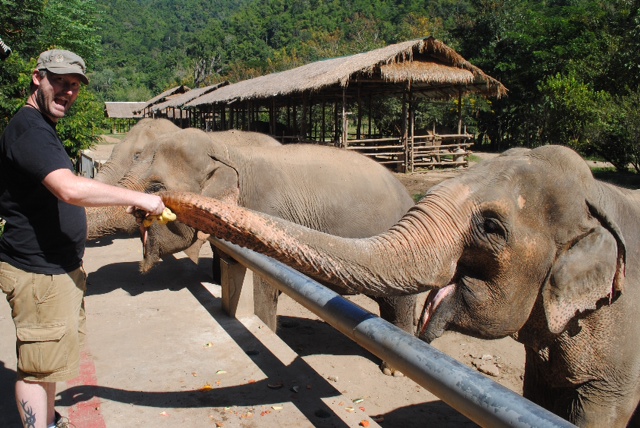
Feeding the elephants. They eat a lot.
Elephant bath time
This is Jokia, the elephant blinded by her owner, and her elephant friend who leads her around and watches out for her.
BFFs. The one on the right has bad hips from a car hitting her while she worked in Bangkok.
This is Hope and his mahout. He's the most naughty elephant at the park, and thus, the star.
Yee Peng Festival
We arrived in Chiang Mai on the opening day of the Yee Peng festival, known by westerners as the floating lantern festival. We had heard rumors that there would be a festival happening in Chaing Mai, and after a google search suspected it to be this festival, but our visit to the town during this time was completely coincidental and we were very lucky. The festival is a religious event celebrating the full moon in November (the 12th lunar month on the Buddhist calendar). The main event is the release of the Khom Loy or floating lanterns. It's believed that your misfortune will float away with the lanterns. The last night of the festival, the 10th, was simply amazing. As we were walking down to the festival we saw people out celebrating everywhere, fireworks going off and lanterns being released all around us. The moon was so bright and you just see thousands of glowing lights floating all around it, it was beautiful. We bought a couple lanterns and set our first one off at a temple. The main places to release your lanterns are at temples and on the bridge, so we did both. The photos don't begin to do justice (there is a video posted on Facebook though!). Everyone is happy and excited to release their lanterns and the feeling is contagious. I still can't believe our luck in being in Chiang Mai during this time, and am ao glad we got to experience this! Also, the street food was the bomb.
During the days we've been visiting many of the temples in the city. There are over 300 temples here, most are very ornate and beautiful.
We've spent the last couple days at the Elephant Nature Park about an hour outside Chiang Mai, that post is coming once I weed through the hu dreds of photos.
Temple in Chiang Mai
Floating lanterns
Releasing a lantern with the full moon behind me
Lantern release at a temple
Releasing a lantern on the bridge
Subscribe to:
Posts (Atom)